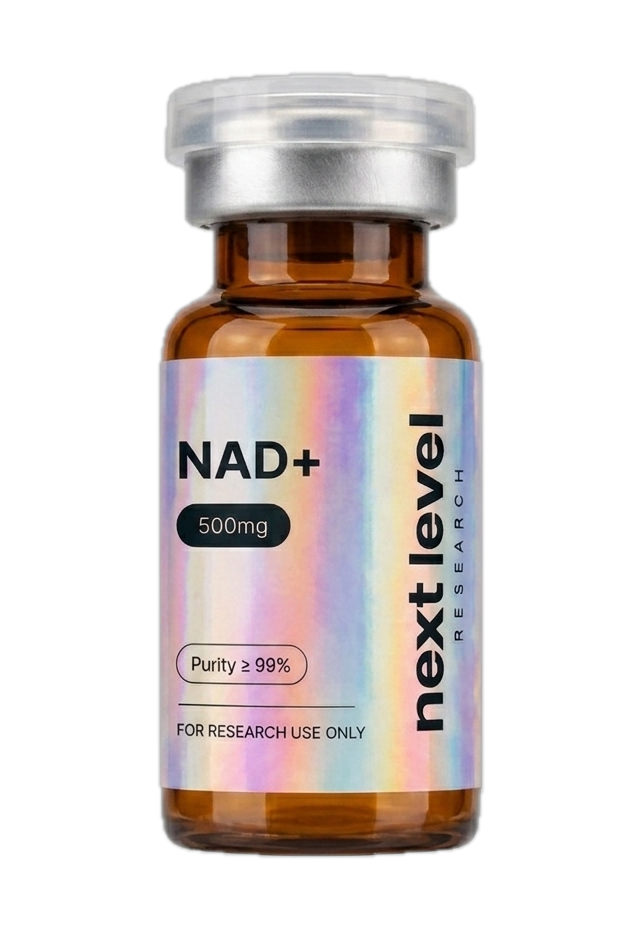
NAD+
Pyridine dinucleotide coenzyme central to cellular redox reactions and a required cofactor for sirtuin, PARP, and CD38 enzyme families. Lyophilized, research-grade.
Compound Profile
Overview
Nicotinamide adenine dinucleotide (NAD⁺) is a coenzyme found in every living cell, where it cycles between oxidized (NAD⁺) and reduced (NADH) forms as an electron carrier in redox reactions. Beyond that redox role it is consumed as a substrate — not merely recycled — by three enzyme families: the sirtuin deacylases, the poly(ADP-ribose) polymerases (PARPs), and the NAD⁺ glycohydrolase CD38. Because those enzymes cleave the molecule rather than return it, cellular NAD⁺ concentration is itself a regulated variable, which is why it is studied in laboratory models of energy metabolism, DNA repair signaling, chromatin modification, and cellular senescence. Supplied as a lyophilized research compound for reconstitution and in vitro assay use.
Key Facts
- Redox cofactor cycling between NAD⁺ and NADH in glycolysis, the TCA cycle, and oxidative phosphorylation
- Consumed as a substrate — not just recycled — by sirtuins, PARPs, and CD38, which is what makes its cellular concentration a regulated variable
- Synthesized in cells by both de novo and salvage pathways, the salvage route running through nicotinamide mononucleotide (NMN)
- The NAD⁺/NADH ratio is a commonly measured readout of cellular redox state in metabolic assays
- Tissue NAD⁺ levels decline with age across multiple model organisms — an observation, not a demonstrated causal mechanism in humans
- Lyophilized; reconstituted with bacteriostatic water for in vitro use
- For research use only — not for human or veterinary administration