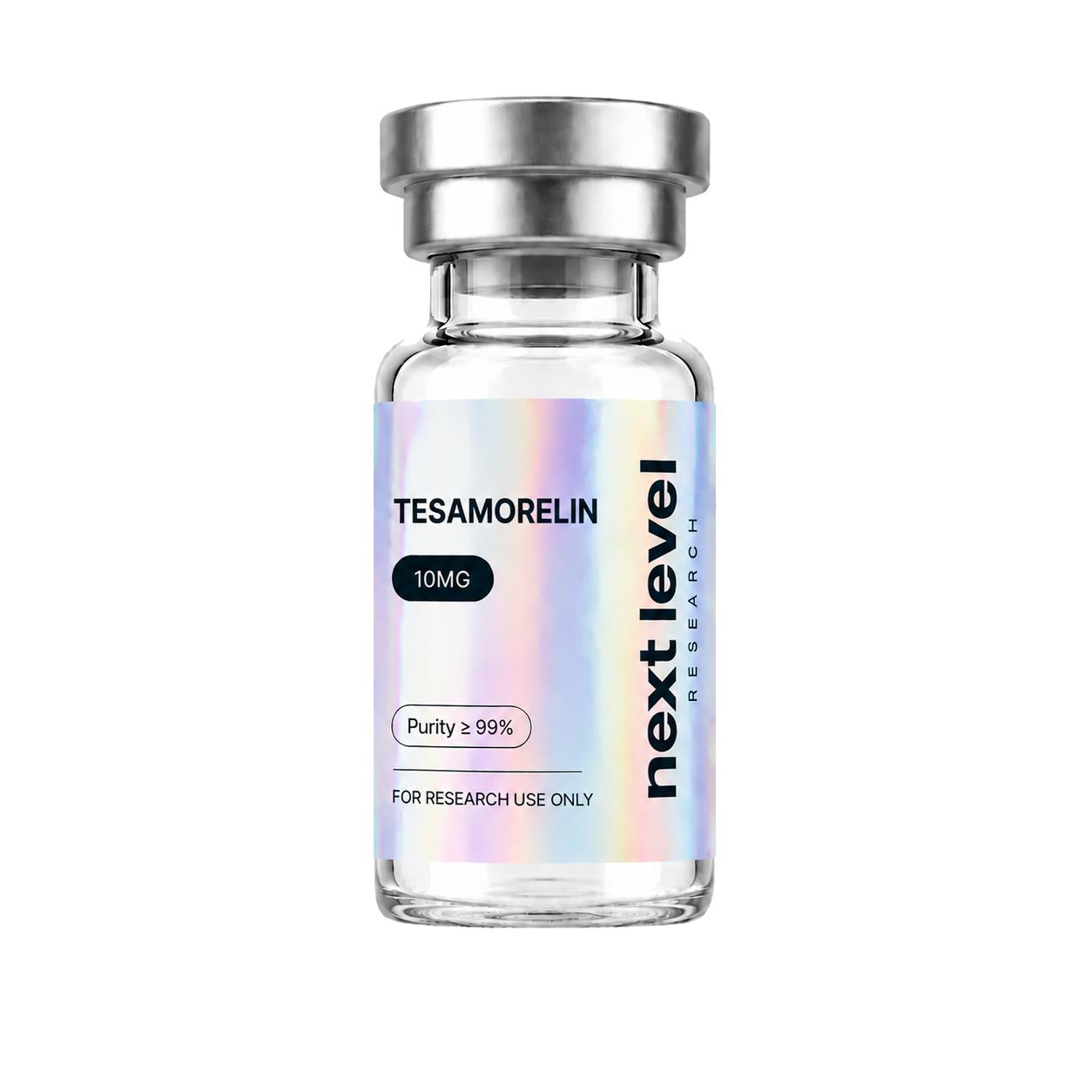
Tesamorelin
A 44-amino acid GHRH analog that stimulates pituitary gh secretion, studied for visceral adipose tissue reduction in clinical research.
Compound Profile
Overview
Tesamorelin is a synthetic analogue of human Growth Hormone-Releasing Hormone (GHRH), a 44-amino acid hypothalamic peptide that stimulates pituitary somatotroph cells to secrete growth hormone (GH) via the GHRH receptor (GHRHR), a Gs-protein-coupled receptor. Unlike CJC-1295 (a truncated GHRH(1-29) analogue), tesamorelin retains the full 44-amino acid sequence of the endogenous hormone with an N-terminal trans-3-hexenoic acid modification that improves resistance to plasma dipeptidyl peptidase IV (DPP-IV) degradation. As a research compound, tesamorelin is used to study GHRH receptor binding kinetics, hypothalamic-pituitary GH axis signaling, and metabolic effects of GHRH receptor activation in preclinical and in vitro models.
Key Facts
- Retains full 44-amino acid sequence of endogenous human GHRH, unlike CJC-1295 which is based on the truncated GHRH(1-29) fragment
- N-terminal trans-3-hexenoic acid modification increases resistance to DPP-IV proteolytic cleavage compared to native GHRH
- GHRH receptor (GHRHR) is a class B G-protein-coupled receptor expressed predominantly on pituitary somatotrophs; activation stimulates cAMP–PKA signaling and GH release
- Endogenous GHRH is secreted in pulsatile fashion from the arcuate nucleus of the hypothalamus and is rapidly degraded in plasma (t½ < 5 min for native GHRH)
- Studied in published clinical research for effects on visceral adipose tissue in the context of metabolic research; that research used pharmaceutical-grade formulations under clinical trial conditions, which are distinct from this RUO compound
- Lyophilized; reconstituted with bacteriostatic water for in vitro or animal model studies
- For research use only — not for human or veterinary administration