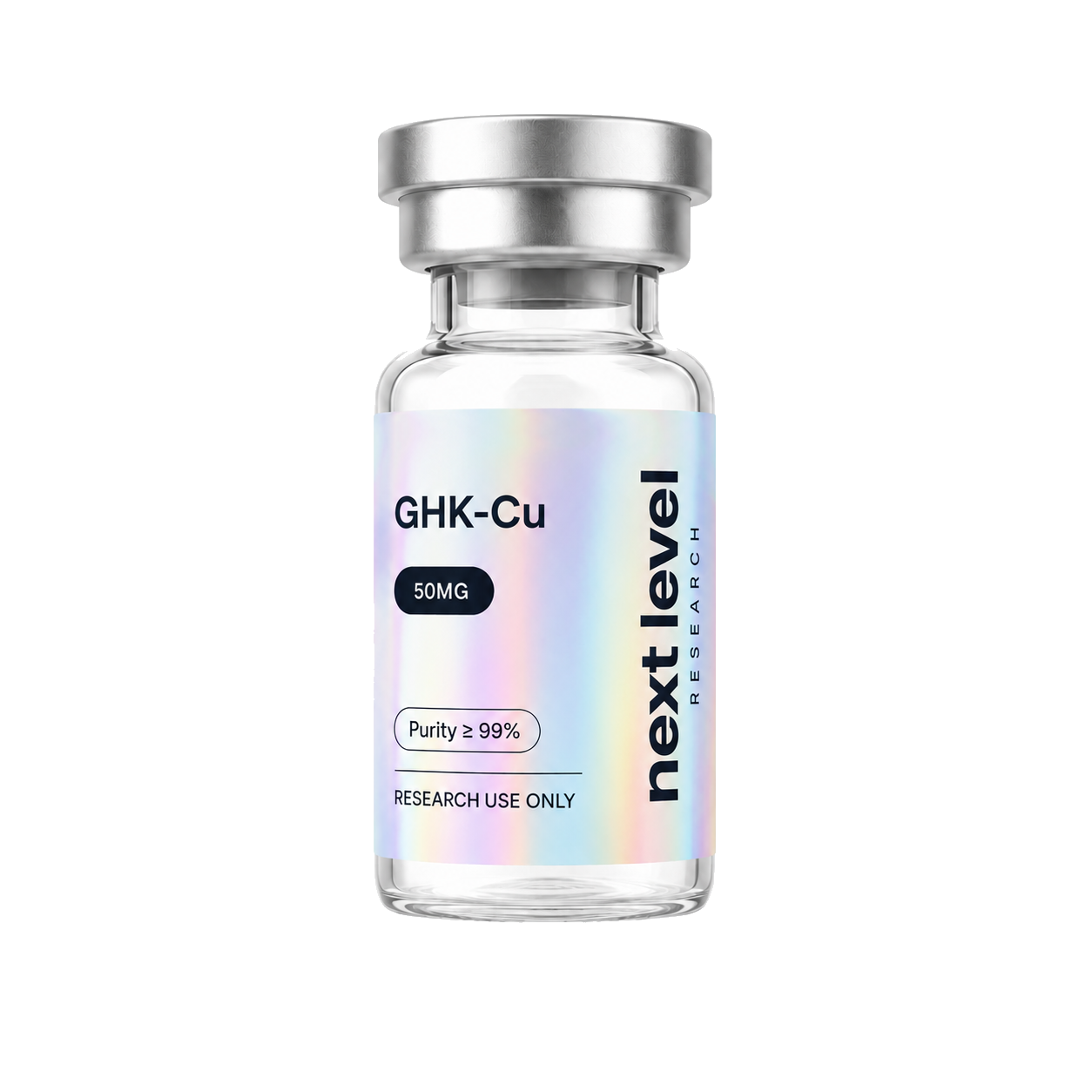
Copper Peptide Complex
GHK-Cu
Naturally occurring copper-binding tripeptide (glycyl-L-histidyl-L-lysine). Lyophilized, triple QC verified.
Compound Profile
Overview
GHK-Cu is a naturally occurring tripeptide–copper complex first isolated from human plasma. The sequence Glycyl-L-Histidyl-L-Lysine forms a high-affinity chelate with cupric ions (Cu²⁺), and this complex is found endogenously in blood, urine, and saliva. It is studied in cell biology research for its role in copper transport, extracellular matrix remodeling, and gene expression modulation. As a lyophilized research compound it is reconstituted with bacteriostatic water for in vitro assay applications.
Key Facts
- Tripeptide with high-affinity Cu²⁺ binding — formation constant ~10¹⁶ M⁻¹
- Naturally present in human plasma at concentrations of ~200 ng/mL
- Involved in copper transport and regulation of cuproenzyme activity in cell studies
- Studied in relation to collagen and extracellular matrix gene expression in fibroblast models
- Lyophilized; reconstituted with bacteriostatic water for in vitro use
- For research use only — not for human or veterinary administration
Published Research
GHK Peptide as a Natural Modulator of Multiple Cellular Pathways in Skin Regeneration
BioMed Research International · 2015 · NCBI
Regenerative and Protective Actions of the GHK-Cu Peptide in the Light of the New Gene Data
International Journal of Molecular Sciences · 2018 · NCBI
Using Copper to Improve the Well-Being of the Skin
Current Chemical Biology · 2014 · NCBI
For laboratory and research use only. This compound is not a drug, food, or cosmetic and is not intended to diagnose, treat, cure, or prevent any disease. Not for human or veterinary use.